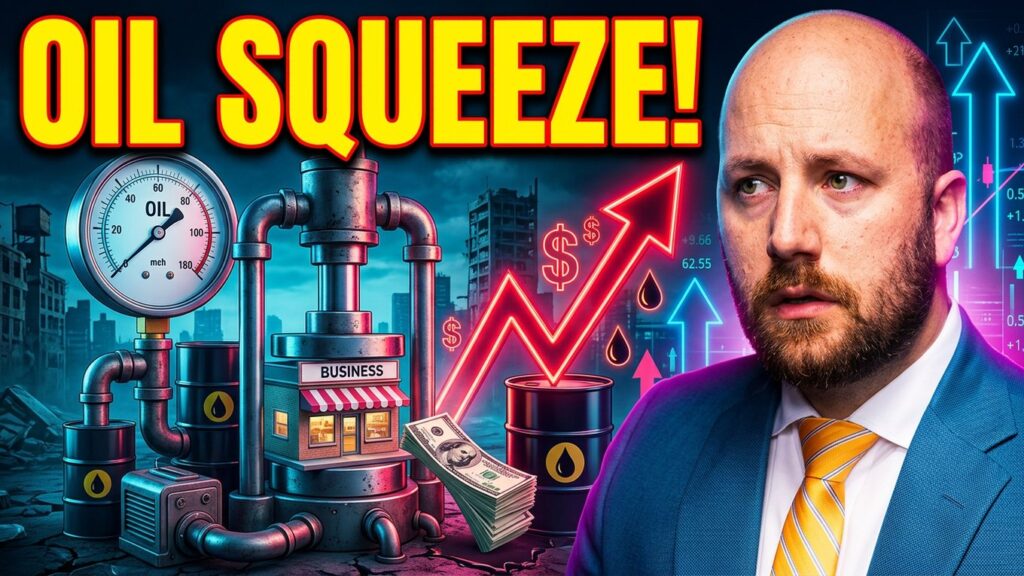
Rising oil prices are hitting small business owners right now—not in some abstract, far-off way, but directly in your margins, your supply chain, and your growth plans. If you think your business is insulated from war overseas or spiking crude prices, think again. The connection between oil prices and small business profitability is immediate and unavoidable.
This is not some geopolitical headline that only matters to people in Washington. This hits Main Street. It hits small business. It hits margins. It hits growth plans. And if you’re not paying attention, it hits you right in the mouth.
How Do Rising Oil Prices Impact Small Business?
Oil is not whispering anymore. It’s roaring.
When oil spikes, transportation costs go up. When transportation costs go up, everything gets more expensive. Goods cost more to move. Services cost more to deliver. Consumers feel it at the pump, but business owners feel it in their P&L.
That’s where it gets real.
According to the U.S. Energy Information Administration, crude oil prices directly influence the cost of diesel, jet fuel, and natural gas—the backbone of commercial logistics. When those prices move, the ripple hits every business that ships a product, delivers a service, or depends on a supply chain. That’s virtually everyone.
Amazon already added a 3.5% surcharge. Airlines are raising fees. Supply chains are tightening. And a lot of business owners are still acting like this is somebody else’s problem.
It’s not.
Are Your Margins Telling You Something?
Look at your numbers. Be honest with yourself.
- Are your margins tighter than they were six months ago?
- Are your expansion plans getting harder to justify?
- Does your cash feel more expensive?
That’s not your imagination. That’s the pressure. And it’s only accelerating.
The Bureau of Labor Statistics tracks how energy costs ripple through the Consumer Price Index, and the data is clear: when oil moves, consumer prices follow—often within 30 to 60 days. Small business owners who don’t adjust within that window are absorbing costs their competitors are passing along.
The Ripple Effect: Why Every Business Is an Energy Business
It’s not just about oil. It’s the ripple effect. Raw materials. Shipping. Labor. Financing. Consumer behavior. Everything is connected. So even if you’re not in energy, energy is in your business.
That’s the point.
The companies that get caught flat-footed in moments like this are the ones that assumed stability would last forever. The ones that survive—the ones that thrive—are the ones that adjust fast.
So ask yourself a hard question:
How much of your pricing strategy is built on yesterday’s cost structure?
Because if your costs are moving and your pricing isn’t, you’re not running a business. You’re bleeding out slowly.
5 Proven Steps to Protect Your Small Business from Rising Oil Prices
This is the season to get aggressive about the fundamentals. Here are five moves every small business owner should be making right now to stay ahead of the oil price squeeze.
1. Revisit Your Pricing Strategy
If your cost to deliver has gone up, your pricing strategy has to reflect reality. Too many business owners are afraid to raise prices because they think they’ll lose customers. But you know what actually loses customers? Going out of business because you refused to charge what your product or service is worth.
Run the numbers. Know your new cost basis. Price accordingly. This isn’t greedy—it’s responsible leadership.
2. Stress Test Your Supply Chain
If one disruption can throw your whole operation off, you’re not lean. You’re overexposed. Identify single points of failure. Diversify your suppliers. Build buffer inventory on critical items. The businesses that survive disruption are the ones that prepared for it before the disruption hit.
3. Protect Cash Flow Ruthlessly
Cut waste. Tighten operations. Get disciplined. Efficiency matters more now than ever. Review every recurring expense. Kill anything that isn’t directly contributing to revenue or retention. Cash is oxygen—and in seasons like this, you need to build leverage and protect your margins at all costs.
4. Communicate Clearly with Your Customers
Customers can handle price increases better than they can handle confusion. Be honest. Be direct. Lead them through it. Explain what’s happening. Explain why. People respect transparency—and they’ll stick with a business that treats them like adults.
The worst thing you can do is quietly shrink portions, reduce quality, or cut corners and hope nobody notices. They notice. They always notice.
5. Double Down on Productivity
Wage pressure is real. Hiring is harder. Your team has to become more effective—not just more expensive. Invest in training. Invest in systems. Invest in AI and automation that multiplies what your team can accomplish. Every dollar you spend making your people better is a dollar that compounds.
Why Innovation Is the Ultimate Hedge Against Oil Prices and Small Business Risk
And above all else: Innovate.
Not because it sounds good in a keynote. Because survival belongs to businesses that move. The ones that sit still get passed, squeezed, or buried. Innovation is one of our core values at Coach Carroll—and in seasons of economic pressure, it stops being a nice-to-have and becomes the difference between thriving and closing your doors.
Look for new revenue streams. Find smarter ways to grow your operation. Adopt technology that reduces your dependence on expensive inputs. The market doesn’t reward the companies that play it safe—it rewards the ones that find a better way forward.
Control the Controllable
That’s the reality. War overseas. Inflation at home. Pressure everywhere.
You may not control any of that.
But you do control your response.
So don’t panic. Don’t freeze. Don’t play defense with your head in the sand.
Control the controllable.
Adjust fast.
Lead hard.
Make the tough calls now—not later.
Because in seasons like this, the market rewards the operators who stay clear, stay tough, and stay moving.
Adapt or get left behind.
That’s the play.
Frequently Asked Questions
How do oil prices affect small business costs?
Oil prices directly increase transportation, shipping, and raw material costs. When crude oil rises, diesel and fuel costs follow, making it more expensive to move goods and deliver services. Small businesses absorb these increases through tighter margins unless they adjust pricing accordingly.
Should small businesses raise prices when oil costs spike?
Yes. If your cost to deliver has increased, your pricing must reflect the new reality. Customers respond better to honest, transparent price adjustments than to declining quality or service cuts. Communicate the reason clearly and lead your customers through the change.
What industries are most impacted by rising oil prices?
Every industry that depends on transportation, logistics, or physical materials is directly affected. This includes retail, construction, manufacturing, food service, and professional services. Even digital businesses feel indirect pressure through higher office costs and reduced consumer spending.
How can I stress test my supply chain?
Identify single points of failure—suppliers, shipping routes, or materials with no backup. Diversify vendors, negotiate fixed-rate contracts where possible, and build buffer inventory on critical inputs. Run a scenario where your primary supplier disappears tomorrow and see what breaks.
What is the best way to protect cash flow during inflation?
Audit every recurring expense and eliminate anything not directly tied to revenue or customer retention. Negotiate payment terms, accelerate collections, and build a 90-day cash reserve. Efficiency and discipline are your greatest assets when costs are rising and margins are tightening.