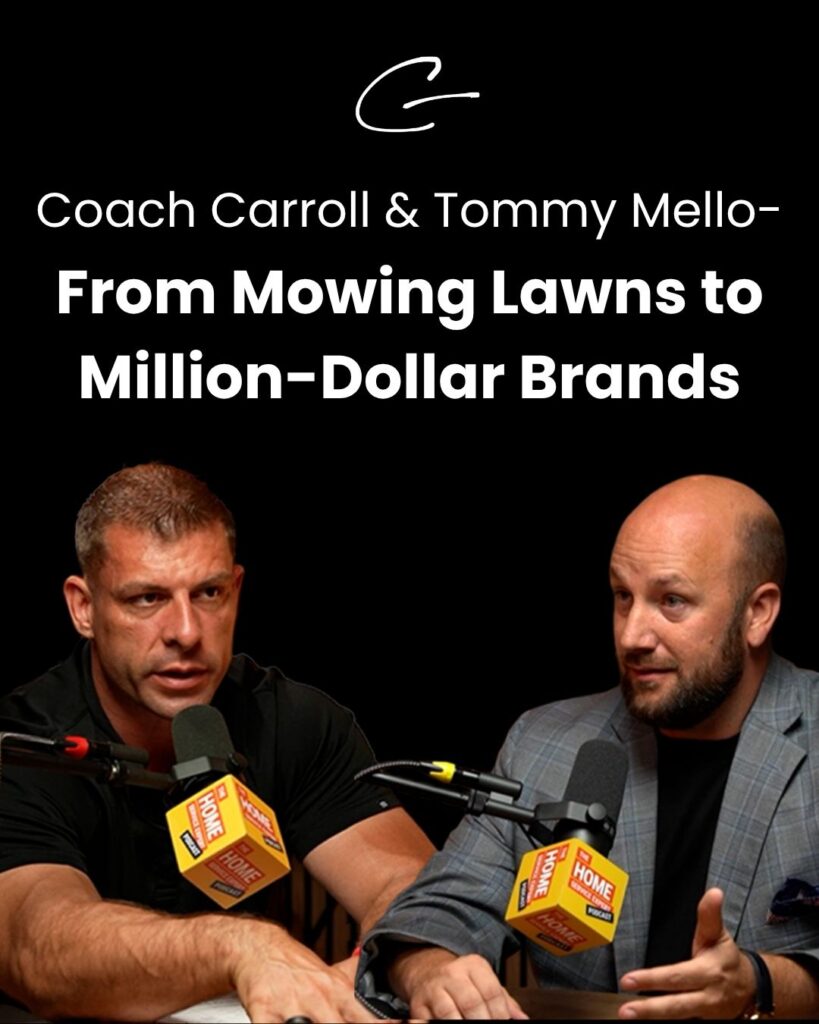
There’s no silver spoon in this story. Tommy Mello built a $200M+ company starting from the garage — literally. And I got my hands dirty early too, mowing lawns and scaling my power washing business before launching Carroll Media. When we sat down together, we went deep on how to scale a small business from hustle mode to real, sustainable growth.
This wasn’t surface-level conversation. This was real talk between two guys who’ve lived it, lost some, won some, and learned a hell of a lot along the way. If you want the playbook for going from grinding to growing, this is it.
What Does It Actually Take to Scale a Small Business?
Scaling isn’t about working harder. Every entrepreneur already works hard. Scaling is about working on the right things and building systems that multiply your output without multiplying your hours.
Tommy said something on the show that stuck: “Most business owners are great technicians trapped inside a business they accidentally built.” That’s the truth. You’re amazing at the work — the service, the product, the craft. But running a business that scales? That’s a completely different skill set.
According to the U.S. Small Business Administration, the most common barrier to scaling is the owner’s inability to transition from operator to leader. Sound familiar?
Tommy Mello’s Playbook for Scaling
Tommy built A1 Garage Door Service from a one-man operation to a nine-figure empire. Here’s what he shared about the journey:
- Hire before you’re ready. If you wait until you’re drowning to hire, you’ll make desperate decisions. Hire ahead of the curve.
- Build the training system first. You can’t scale people if you can’t train them consistently. SOPs and training programs are the foundation of every scalable company.
- Track everything. Revenue per truck. Cost per lead. Conversion rate. Close rate. If you’re not measuring it, you’re guessing — and guessing doesn’t scale.
- Invest in marketing early and often. Tommy didn’t wait until he had “extra” money to market. He treated marketing as a core business function from day one.
5 Lessons on How to Scale a Small Business
1. Stop Being the Bottleneck
If your business can’t function without you for a week, it’s not a business — it’s a job. Start by identifying every task that only you do and systematically create a way for someone or something else to handle it. Scale requires removing yourself from the daily operations.
2. Build a Culture That Scales
Tommy’s culture at A1 is legendary. Clear values. High standards. Accountability at every level. Culture is what keeps the machine running when you’re not in the room. Without it, every new hire dilutes your standards instead of amplifying them.
3. Master Your Numbers
Scaling without financial clarity is like driving blindfolded. Know your cost per acquisition. Know your lifetime customer value. Know your margins at every level of the operation. The businesses that scale fastest are the ones that know their numbers cold, especially when costs are shifting.
4. Leverage Technology Ruthlessly
Tommy and I agree: technology is an unfair advantage for the businesses that adopt it first. CRMs, AI, automated scheduling, digital marketing — every tool that removes friction from your operation is a tool that helps you scale. The AI prompt playbook is the latest version of this principle.
5. Learn From People Who’ve Done It
Neither Tommy nor I learned to scale from a textbook. We learned from mentors who had already done it, from masterminds with other operators, and from the expensive mistakes we made along the way. Shorten your learning curve by surrounding yourself with people ahead of you.
The Truth About the Hustle Phase
Both Tommy and I are proud of our hustle origins. But here’s the truth: the hustle phase is supposed to be temporary. If you’re still in pure hustle mode after five years, something is broken in your systems, not your work ethic.
The transition from hustle to scale is the hardest and most important move any entrepreneur will make. It requires letting go, building trust, and investing in systems that feel expensive until they start compounding.
Hustle to start. Scale to last. That’s the play.
Frequently Asked Questions
How do I scale a small business?
Remove yourself as the bottleneck, build systems and SOPs, hire ahead of demand, track your numbers obsessively, and leverage technology. Scaling is about multiplying output through systems, not multiplying your personal hours.
When should I transition from hustle to scale?
When you’re consistently generating revenue but can’t grow because you’re maxed out personally. If adding more customers means adding more of your own hours, you’ve hit the hustle ceiling and need to build systems that operate independently.
What numbers should I track to scale?
Cost per acquisition, lifetime customer value, gross margin per service, close rate, revenue per employee, and cash flow. These metrics tell you exactly where to invest and what to fix. Guessing doesn’t scale — measuring does.
How did Tommy Mello build a $200M company?
By building systems before scaling, hiring ahead of demand, investing heavily in training and culture, tracking metrics obsessively, and marketing consistently from day one. He treated his garage door business like a franchise model from the start.
What is the biggest mistake when trying to scale?
Trying to grow revenue without building infrastructure first. More customers without better systems means more chaos, higher costs, and declining quality. Build the systems first, then pour gas on the growth engine.